Disclosure: We earn commissions from partner links. This doesn't affect our rankings. Learn more
Hostinger VPS Review 2026: Best for Beginners?
Hostinger is the best choice for self-hosting beginners who want an easy setup experience backed by responsive support. The introductory pricing is compelling, though renewal rates are a concern. If you are new to VPS hosting and want a guided experience, Hostinger delivers. Power users should consider Hetzner or DigitalOcean for more advanced features.
Hostinger Score Breakdown
Pros & Cons
Advantages
Extremely beginner-friendly interface
Hostinger's custom hPanel is designed for newcomers, with guided setup wizards, one-click installers, and a clean dashboard that avoids overwhelming users with technical jargon.
Excellent 24/7 live chat support
Support agents are available around the clock via live chat and consistently receive high satisfaction ratings. Average response time under 2 minutes during business hours.
Strong introductory pricing
First-term prices are among the lowest in the industry, especially on longer commitments, making it affordable to get started with self-hosting.
Global data center coverage
Data centers across North America, Europe, Asia, and South America provide low-latency options for users worldwide.
Built-in AI assistant
An integrated AI tool helps with server configuration, troubleshooting, and provides contextual recommendations for optimizing your setup.
One-click OS templates
Pre-configured templates for popular Linux distributions and applications let you deploy a working server in minutes.
Weekly automatic backups included
All VPS plans include automatic weekly backups at no extra cost, providing a safety net without additional configuration.
Dedicated IP on all plans
Every VPS comes with a dedicated IPv4 address included in the price, unlike some providers that charge extra.
Disadvantages
Significant renewal price increase
After the initial term, prices typically double or triple. A plan advertised at $4.99/mo may renew at $11.99/mo or higher.
No hourly billing option
Unlike Hetzner or DigitalOcean, Hostinger requires monthly or longer commitments. No pay-by-the-hour flexibility for testing.
Limited API functionality
The API is less mature than competitors, making infrastructure-as-code workflows more difficult to implement.
No managed Kubernetes
Container orchestration must be set up manually. No managed Kubernetes service available for scaling container workloads.
Lower bandwidth allocations
Bandwidth limits are tighter than Hetzner or Vultr, which could be an issue for high-traffic self-hosted applications.
No object storage service
Hostinger does not offer S3-compatible object storage, so you'll need a third-party solution for large file storage needs.
Hostinger Pricing Plans
| Plan | CPU | RAM | Storage | Bandwidth | Price | |
|---|---|---|---|---|---|---|
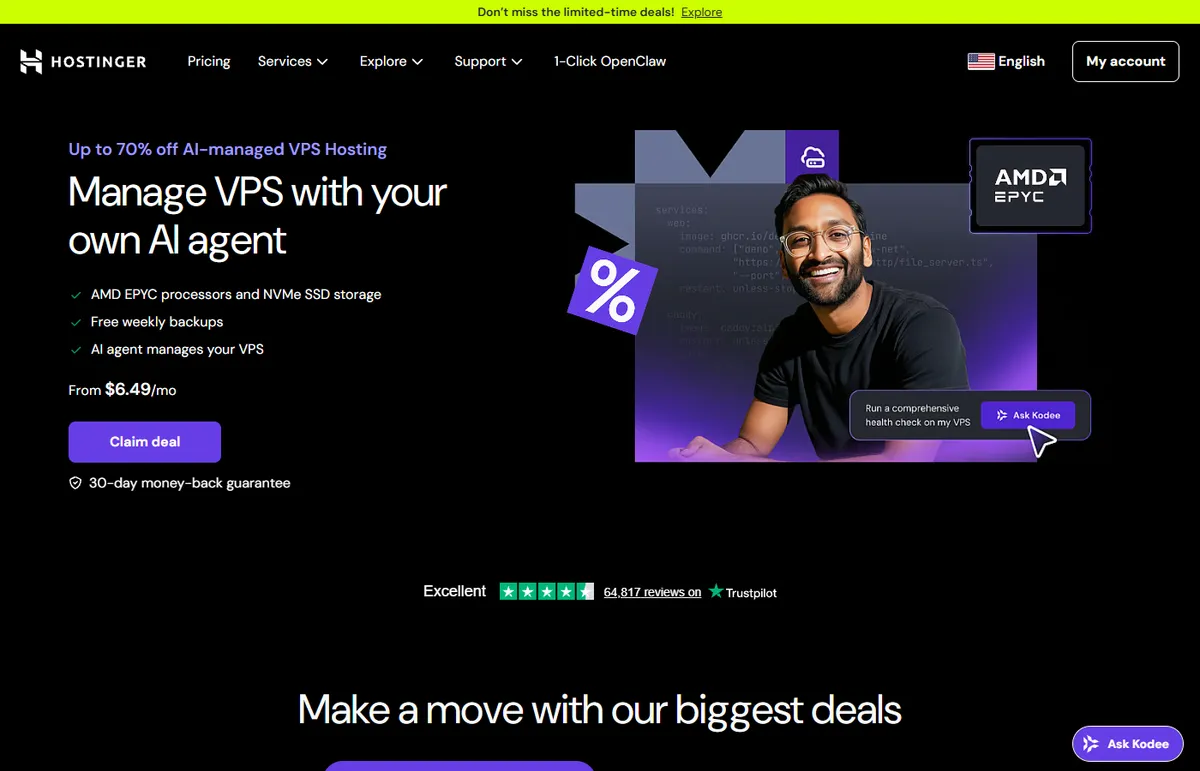
| KVM 1 | 1 vCPU | 4 GB | 50 GB NVMe | 4 TB | $6.49/mo | Get Started → |
| KVM 2 Best Value | 2 vCPU | 8 GB | 100 GB NVMe | 8 TB | $8.99/mo | Get Started → |
| KVM 4 | 4 vCPU | 16 GB | 200 GB NVMe | 16 TB | $12.99/mo | Get Started → |
| KVM 8 | 8 vCPU | 32 GB | 400 GB NVMe | 32 TB | $25.99/mo | Get Started → |
| Competitor comparison (similar specs): Hetzner: $4.15/mo DigitalOcean: $24.00/mo Vultr: $10.00/mo | ||||||
Hostinger vs Competitors: Feature Comparison
| Feature | Hostinger | Hetzner | DigitalOcean |
|---|---|---|---|
| NVMe SSD Storage | Regular SSD on basic | ||
| Hourly Billing | Monthly minimum | ||
| Load Balancers | |||
| Managed Kubernetes | |||
| Managed Databases | Not available | Postgres, MySQL, Redis, MongoDB, Kafka, Valkey, OpenSearch | |
| Object Storage | Spaces | ||
| Floating IPs | Reserved IPs | ||
| Firewalls | |||
| Snapshots | |||
| Backups | Weekly included | 20% of server price | 20% of Droplet price |
| Private Networking | VPC | ||
| IPv6 Support | |||
| API Access | Limited | ||
| Terraform Provider | |||
| One-Click Apps | Large selection | Limited selection | 100+ images |
| DDoS Protection | Basic included |
What Can You Self-Host on Hostinger?
Hostinger Support & Community
- Live Chat
- Ticket System
- Knowledge Base
Who Should Use Hostinger?
Ideal For
- Complete beginners who want the easiest VPS setup experience
- Users on a tight budget who can commit to longer billing terms
- WordPress and blog self-hosters seeking one-click templates
- Anyone who values responsive 24/7 live chat support
Not Ideal For
- Power users who need hourly billing and advanced cloud features
- DevOps teams requiring Terraform, API automation, or Kubernetes
- Projects needing object storage or private networking
- Users sensitive to renewal price increases after the initial term
Frequently Asked Questions
Is Hostinger good for beginners?
Yes. Hostinger is one of the most beginner-friendly VPS providers. The hPanel control panel is intuitive, support is responsive, and one-click templates make deploying self-hosted apps straightforward.
What happens when Hostinger prices renew?
Hostinger uses introductory pricing on the first term. Expect renewal prices to be 2-3x higher. We recommend locking in the longest term you are comfortable with to maximize savings.
Does Hostinger offer managed hosting?
Hostinger VPS plans are unmanaged, but the interface and support make them accessible to less technical users. They do offer managed WordPress hosting as a separate product.
Can I host Docker containers on Hostinger?
Yes. You can install Docker on any Hostinger VPS. However, there is no managed container orchestration, so you will manage Docker Compose or Kubernetes yourself.
How does Hostinger compare to Hetzner?
Hostinger is more beginner-friendly with better support, while Hetzner offers better raw value and more cloud features. Hetzner is better for experienced users; Hostinger suits those who want hand-holding.
Does Hostinger have a money-back guarantee?
Yes. Hostinger offers a 30-day money-back guarantee on most plans. If you are not satisfied, you can request a full refund within the first 30 days.
Where are Hostinger data centers?
Hostinger has data centers in the US, UK, Netherlands, Lithuania, Singapore, India, and Brazil, offering global coverage for low-latency deployments.